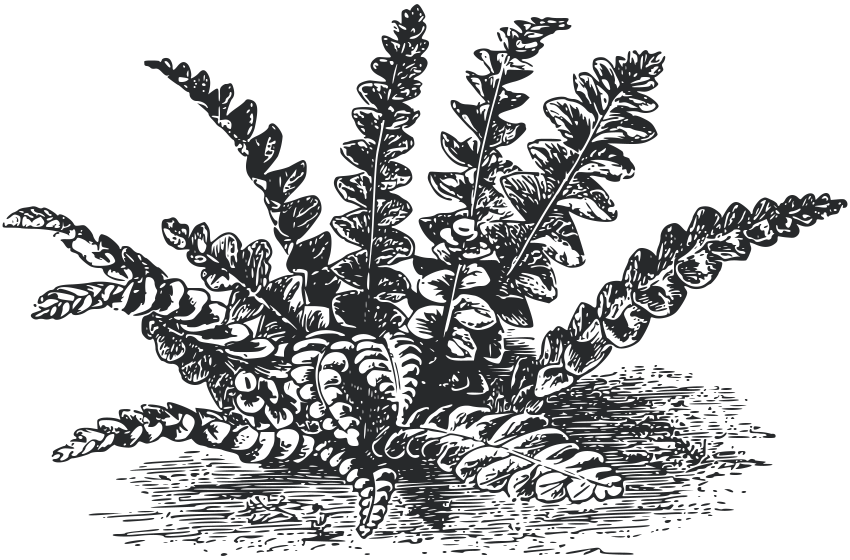
Serapias vomeracea (Burm.f.) Briq., 1910
Common names
- 🇫🇷 Sérapias en soc, Sérapias à labelle long, Sérapias à labelle allongé
Taxonomy
- Kingdom: Plantae
- Clade: Tracheophytes
- Clade: Angiosperms
- Clade: Monocots
- Order: Asparagales
- Family: Orchidaceae
- Subfamily: Orchidoideae
- Tribe: Orchideae
- Subtribe: Orchidinae
- Genus: Serapias
- Species: Serapias vomeracea
Presence
Present.
Conservation status
- Red List (Metropolitan France): LC Least Concern
- Red List (Europe): LC Least Concern
Notes
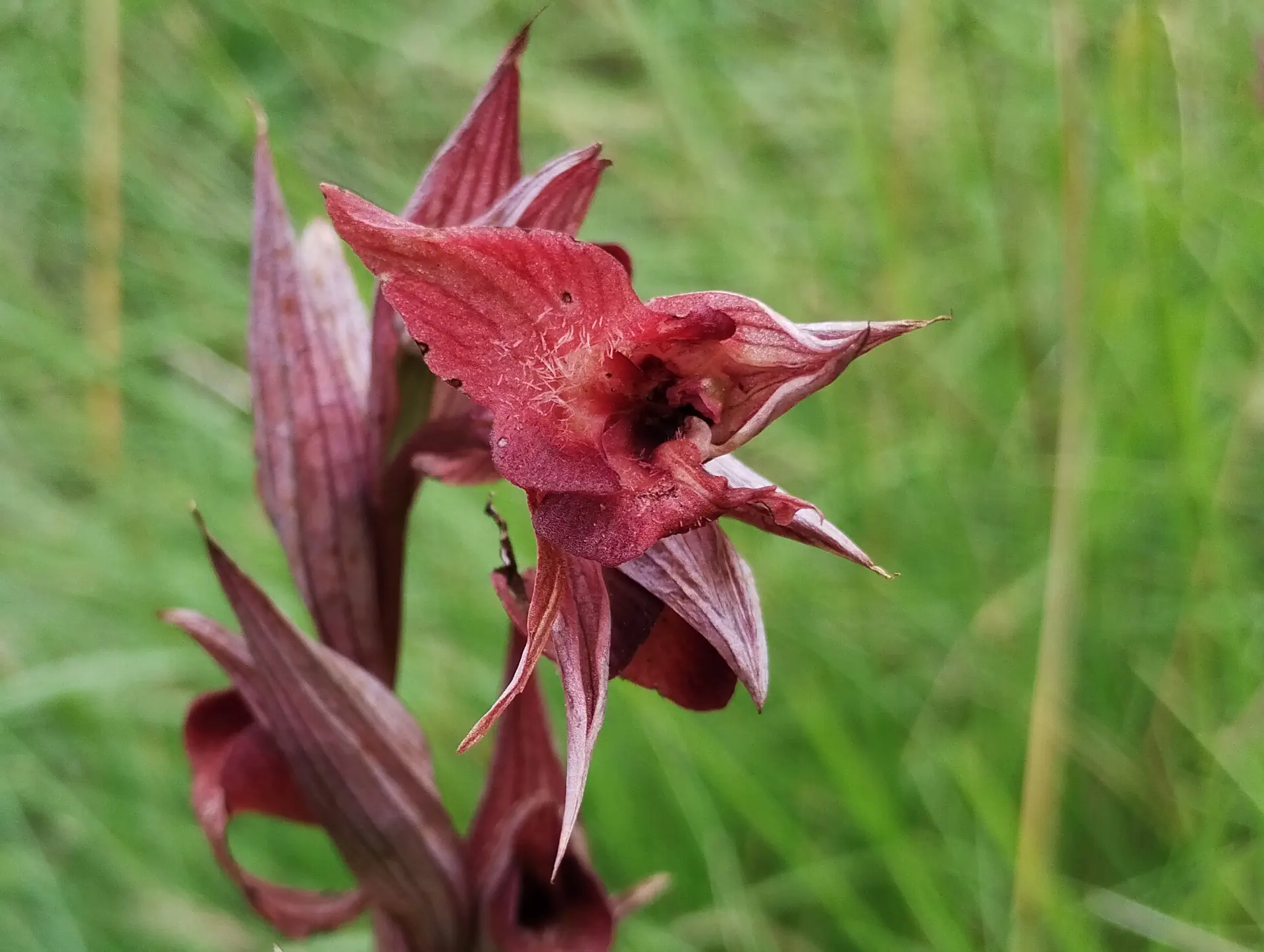
Possible confusion with S. cordigera L., 1763, whose flowers are dark reddish-purple, with a broad, heart-shaped labellum, while those of S. vomeracea (Burm.f.) Briq., 1910 are light reddish-purple, with a narrow, elongated labellum.
Bees belonging to the genus Eucera - e.g. E. longicornis - are often found sleeping inside the flowers, which plays a role in the pollination process (Dafni et al., 1981).
The following infraspecific taxa are accepted:
- S. vomeracea var. guadarramica (Kreutz) P.Delforge, 2015;
- S. vomeracea var. longipetala (Ten.) Kreutz, 2006;
- S. vomeracea var. vomeracea (Burm.f.) Briq., 1910, P.
Hybridizes with:
- S. cordigera L., 1763 to produce S. × kelleri A.Camus, 1926, P;
- S. lingua L., 1753 to produce S. × intermedia Forest. ex F.W.Schultz, 1851, P;
- S. neglecta De Not., 1844 to produce S. × alberti E.G.Camus, 1892, P;
- S. parviflora Parl., 1837 to produce S. × broeckii A.Camus, 1926, P.
Intergeneric hybridization is also possible with:
- Anacamptis coriophora (L.) R.M.Bateman, Pridgeon & M.W.Chase, 1997 to produce × Serapicamptis tommasinii (A.Kern.) J.M.H.Shaw, 2005, P;
- Anacamptis morio subsp. picta (Loisel.) Jacquet & Scappat., 2003 to produce × Serapicamptis fontanae (E.G.Camus) H.Kretzschmar, Eccarius & H.Dietr., 2007, P;
- Anacamptis papilionacea (L.) R.M.Bateman, Pridgeon & M.W.Chase, 1997 to produce × Serapicamptis ligustica (E.G.Camus) J.M.H.Shaw, 2005, P;
- Anacamptis pyramidalis (L.) Rich., 1817 to produce × Serapicamptis traverseriana S.Baumann, 2011, P.
Photographs


Anomalies
Sources
Dafni, A., Ivri, Y., & Brantjes, N.B.M. (1981). Pollination of Serapias Vomeracea Briq. (Orchidaceae) by Imitation of Holes for Sleeping Solitary Male Bees (Hymenoptera). Acta Botanica Neerlandica, 30(1-2), 69-73. https://doi.org/10.1111/j.1438-8677.1981.tb00388.x
Kühn, R., Pedersen, H.Æ., & Cribb, P. (2020). Orchidées d’Europe et de Méditerranée (p. 349). Biotope.
Rankou, H. (2011). Serapias vomeracea (Europe assessment). The IUCN Red List of Threatened Species, 2011. https://www.iucnredlist.org/species/175954/7152700
Tison, J.M., & de Foucault, B. (2014). Flora Gallica : Flore de France (p. 187). Biotope.