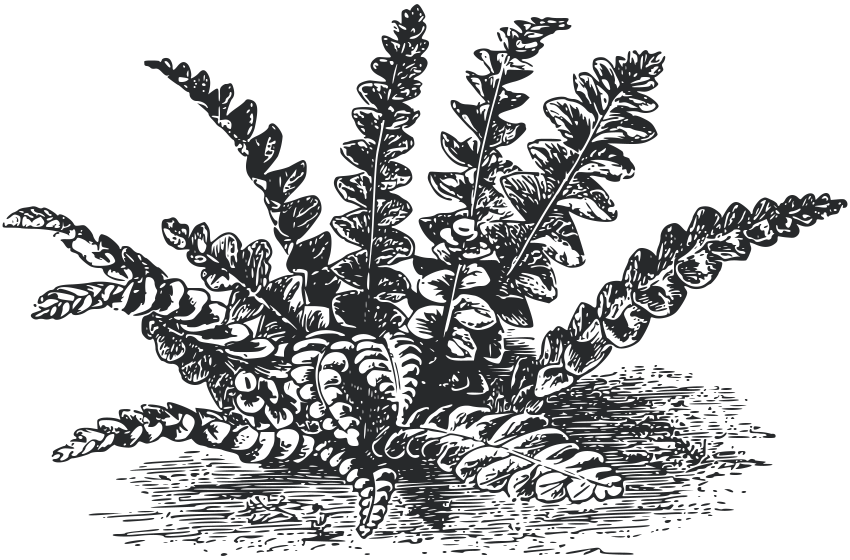
Asplenium trichomanes subsp. trichomanes L., 1753
Common names
- 🇬🇧 Maidenhair Spleenwort
- 🇫🇷 Doradille des murailles, Capillaire des murailles, Fausse capillaire, Capillaire rouge
Taxonomy
- Kingdom: Plantae
- Clade: Tracheophytes
- Clade: Monilophytes
- Class: Polypodiopsida
- Subclass: Polypodiidae
- Order: Polypodiales
- Suborder: Aspleniineae
- Family: Aspleniaceae
- Genus: Asplenium
- Species: Asplenium trichomanes subsp. trichomanes
Presence
Present.
Conservation status
- Red List (Metropolitan France): LC Least Concern
Notes
Type subspecies with a reddish-brown rachis, whose fronds gradually become narrower, whose terminal segment is slightly reduced, and whose pinnae are rounded. The pinnae are inserted slightly obliquely on the rachis and are spaced more or less evenly, especially on the upper half of the frond. Diploid (2n = 72).
Hybridizes with:
- A. foreziense Le Grand ex Magnier, 1884 to produce A. × pagesii nothosubsp. guichardii (Litard.) Viane, Boudrie, Rasbach & K.Rasbach, 2003, P;
- A. septentrionale subsp. septentrionale (L.) Hoffm., 1796 to produce A. × alternifolium nothosubsp. alternifolium Wulfen, 1781, P;
- A. trichomanes subsp. inexpectans Lovis, 1964 to produce A. trichomanes nothosubsp. melzerianum S.Jess., 1995, P;
- A. trichomanes subsp. quadrivalens D.E.Mey., 1962 to produce A. trichomanes nothosubsp. lusaticum (D.E.Mey.) Lawalrée, 1978, P.
Photographs


Sources
Badré, F., & Deschatres, R. (1979). Les Ptéridophytes de la France : liste commentée des espèces (taxinomie, cytologie, écologie et répartition générale). Candollea, 34(2), 379-457. https://doi.org/10.5169/seals-880127
Prelli, R., & Boudrie, M. (2024). Les fougères et plantes alliées d’Europe (2nd ed., p. 297). Biotope.
Tison, J.M., & de Foucault, B. (2014). Flora Gallica : Flore de France (p. 6). Biotope.